Five Modes of AI: Match the Machine to the Need
AI maturity is not climbing from questions to agents. It is knowing whether you need an oracle, generator, collaborator, agent, or dialectical mirror, then judging when the answer is enough, when to dig deeper, and when to switch modes.

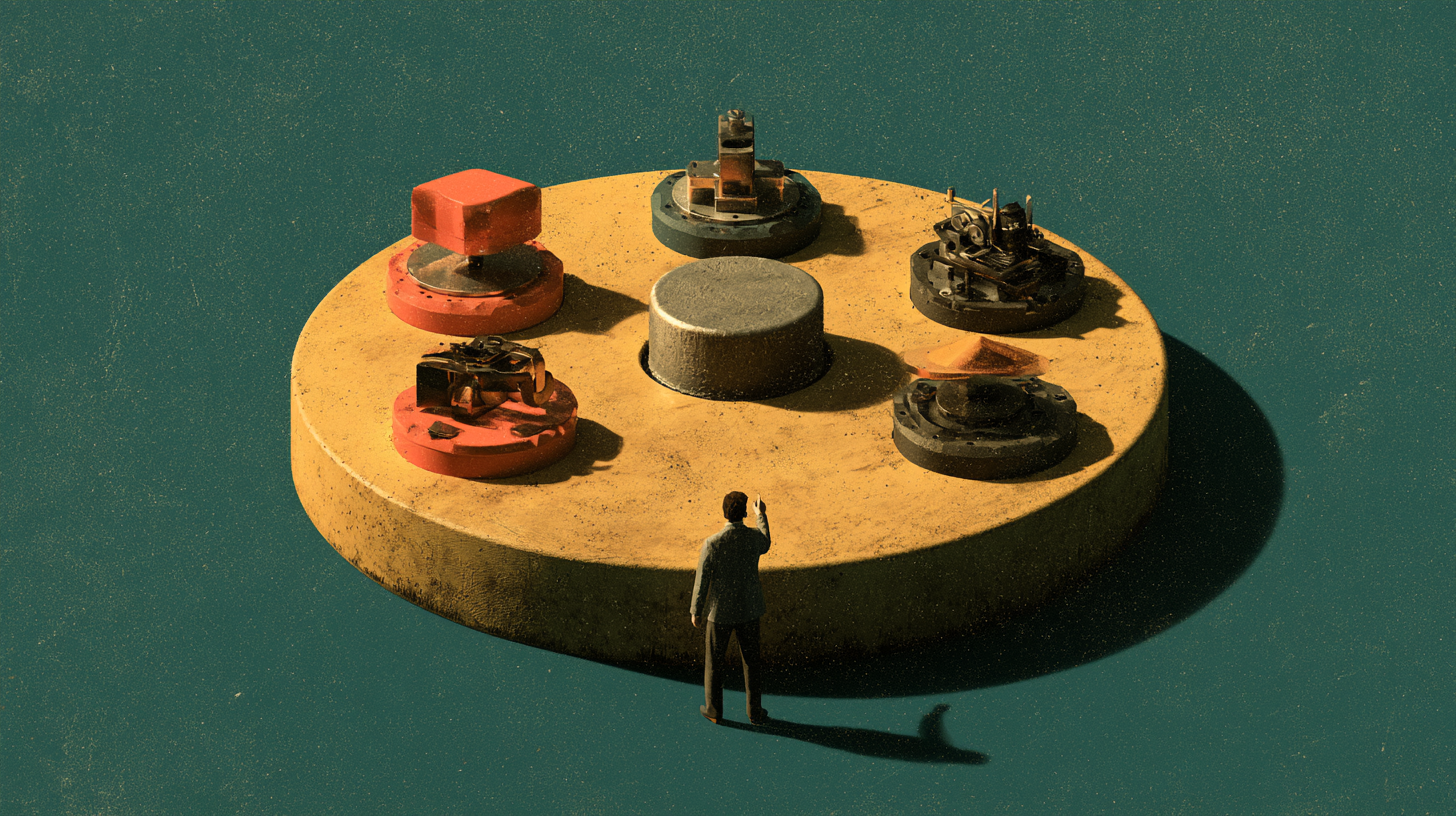
Most conversations about AI maturity are really conversations about capability.
First you ask ChatGPT questions. Then you learn better prompting. Then you use it to generate code and documents. Eventually you build agents that perform entire workflows.
It sounds like a ladder.
I think that framing is wrong.
An autonomous agent is not a more mature way to check a fact. A long dialectical conversation is a terrible way to generate forty routine unit tests. And asking an AI for an answer when you have not actually figured out the problem can give you a wonderfully articulated answer to the wrong question.
The useful distinction is not how advanced the AI is.
It is what you need from it right now.
I see five recurring modes:
Oracle
Generator
Collaborator
Agent
Dialectical Mirror
Each solves a different problem.
AI maturity is not progressing through them from Level 1 to Level 5.
AI maturity is recognizing your current need, selecting the right mode, knowing when that mode has stopped being sufficient, and switching.
That last part matters more than it sounds.
1. Oracle: I Need to Know
This is probably the most familiar interaction with AI.
What does this error mean?
Explain this architecture.
Summarize this document.
What is the difference between these two approaches?
The relationship is simple:
Human asks → AI answers
This is incredibly useful.
Search becomes synthesis. Documentation becomes conversational. The cost of entering an unfamiliar domain collapses.
But Oracle mode contains one of the easiest traps in AI.
The model gives you a plausible answer.
Now what?
There is a decision that happens after every answer, whether you consciously make it or not: Accept or dig?
For a low-consequence, well-bounded question, acceptance is often exactly right.
You needed syntax. You got syntax. Move on.
Maturity does not mean interrogating everything the model says.
But sometimes the answer rests on assumptions that matter. Sometimes it conflicts with what you already know. Sometimes the consequences of being wrong are significant. Sometimes the answer is technically correct but does not explain what you are actually observing.
That is the moment to dig.
Why?
What assumption is that based on?
How confident are you?
What would make this answer wrong?
What evidence would distinguish these explanations?
Something interesting then happens.
Oracle mode begins to become Dialectical Mirror.
You stop asking the AI for a conclusion and start using it to expose the structure behind the conclusion. You have not permanently graduated from one level to another. Your need changed, so you changed modes.
This is where many people lose a large part of AI’s value. They either accept every plausible answer too quickly or distrust the system so completely that they interrogate even the trivial answers.
The skill is knowing which situation you are in.
2. Generator: I Need to Make
Sometimes there is nothing profound to discover.
You need output.
Write this function.
Draft this email.
Generate these tests.
Turn these notes into a proposal.
Give me ten variations.
The loop becomes:
Human specifies → AI produces → Human evaluates
This is where much of the current AI productivity story lives.
And rightly so.
AI dramatically reduces the cost of producing a first implementation, draft, design, analysis, or variation.
The human contribution shifts from production toward specification and judgment.
But Generator mode has its own trap: Premature satisfaction.
The artifact exists. It looks plausible. Therefore it must be done.
Generation makes producing something so cheap that the ability to determine whether it is good becomes more important, not less.
Sometimes the output is sufficient.
Ship it.
Sometimes evaluating it exposes a deeper problem.
Then the correct move is not necessarily another prompt asking for another generation. It may be time to switch modes.
3. Collaborator: I Need to Develop
You know roughly where you are going, but the destination is not sufficiently specified to simply request the output.
So you work it out together.
Here is what I am thinking.
That is not quite right.
Move this responsibility here.
Compare this against the earlier design.
Keep that part, throw away the rest.
Okay. Now we are getting somewhere.
The loop becomes:
Human proposes → AI extends → Human evaluates → AI revises
This is different from prompting for a better artifact.
The artifact and the understanding of the artifact develop together.
Pair programming is an obvious example, but the same interaction works for architecture, strategy, writing, product design, research, and planning.
You no longer need to completely specify the destination before beginning.
That is enormously powerful.
The failure mode here is different again: Endless iteration.
Because iteration is nearly free, it becomes easy to continue polishing long after additional iteration has stopped creating meaningful value.
The mature move may be to accept the result.
Or it may be to hand the now-understood work to an agent.
4. Agent: I Need Something Done
Sometimes the problem is understood well enough that you no longer need to remain inside every step.
You need the work performed.
Upgrade these dependencies and resolve the failures.
Research these options and produce a recommendation.
Process these documents and flag the exceptions.
Implement this issue and open a pull request.
The relationship changes:
Human defines the objective and constraints → AI plans and acts → System verifies → Human handles exceptions
The value of Agent mode is not that the model produces a larger answer.
It is that responsibility for navigating part of the task moves into a bounded execution loop.
The human specifies the objective, establishes authority, defines evidence and verification, and decides what requires escalation. The agent determines how to move from the current state toward the desired state.
This can create enormous leverage, but it also introduces a more serious failure mode: Delegation without verification.
A generator can give you a bad draft. An agent can act on a bad interpretation.
The mature use of an agent therefore depends on boundaries, observable state, validation, and a clear understanding of which decisions have actually been delegated.
Sometimes Agent mode is exactly what you need.
Sometimes the objective is still too ambiguous. In that case, adding autonomy does not solve the ambiguity. It operationalizes it.
You may need to return to Collaborator mode and understand the work before delegating it again.
5. Dialectical Mirror: I Need to Think
Sometimes you do not need an answer, artifact, collaborator, or delegate.
You need to discover what you think.
You begin with a partial idea:
I think software factories eventually behave more like organisms than pipelines.
The AI reflects or challenges it:
No. “Organism” implies too much autonomy. The interesting property is adaptation under governance.
You push against the distinction:
But if the governance system is itself adaptive, where does authority terminate?
Now the conversation is no longer about retrieving an answer.
The loop becomes:
Human forms a hypothesis → AI reflects, extends, or attacks → Human identifies contradiction → AI reconstructs → Human updates their mental model
This is AI as a dialectical mirror.
The model gives your thinking an external surface. It reflects compressed ideas back in expanded form, allowing you to inspect assumptions, contradictions, consequences, and connections that were previously implicit.
The value does not come from treating the model as correct.
It comes from having something capable of holding the structure of the argument while you push against it.
The Model Can Be Wrong and Still Be Useful
This mode requires a very different relationship with AI.
If you treat the model as an authority, you get an oracle.
If you treat it as a production engine, you get a generator.
If you treat every response as something to agree with, you can create confirmation bias at machine speed.
Dialectical use requires friction.
What is wrong with this?
Attack the premise.
What assumption are we both making?
If the opposite were true, what else would have to change?
But it also requires being willing to tell the model:
No. You missed it.
That moment can be surprisingly valuable.
Explaining why the reflection is wrong forces you to articulate something that may previously have existed only implicitly in your head.
The model’s mistake exposes a distinction.
The distinction changes your model.
The wrong answer helped produce the right question.
That is a very different conception of AI utility.
The failure mode here is recursive abstraction.
You can think forever.
At some point the additional insight no longer changes the decision.
Then maturity means leaving the mirror and doing something.
These Are Modes, Not Levels
It is tempting to arrange these modes into a maturity ladder:
- Ask questions
- Generate artifacts
- Collaborate
- Delegate
- Think dialectically
But that would reproduce the same mistake in a slightly more sophisticated form.
The modes are not replacements for one another.
Oracle mode is the correct tool when you need a fact. Generator mode is the correct tool when you need routine output. Agent mode is wasteful when the task takes thirty seconds to perform directly. Dialectical Mirror mode is actively unhelpful when the problem is already understood and execution is all that remains.
The mature user still uses every mode.
What changes is the ability to recognize which one the moment requires.
AI Maturity Is a Control Loop
The real maturity model is not a ladder.
It is a control loop:
Need → Select Mode → Interact → Evaluate → Accept or Dig → Switch Mode → Repeat
The critical judgment gate is:
Accept or dig?
Is the answer enough?
Is the artifact good enough?
Has collaboration converged?
Is the objective clear enough to delegate?
Has further thinking stopped changing the decision?
Maturity is not maximum depth. It is calibrated depth.
Each Mode Has a Failure Condition
| Mode | Need | Failure condition | Switch when... |
|---|---|---|---|
| Oracle | I need to know | Premature acceptance | The assumptions matter more than the answer |
| Generator | I need to make | Premature satisfaction | You cannot confidently judge the output |
| Collaborator | I need to develop | Endless iteration | The objective and acceptance criteria have stabilized |
| Agent | I need something done | Delegation without verification | Ambiguity or exceptions exceed its authority |
| Dialectical Mirror | I need to think | Recursive abstraction | Further insight no longer changes the decision |
No mode is inherently mature.
Maturity appears in how the user enters, operates, evaluates, and exits each one.
The Missing Skill Is Mode Switching
Most AI guidance teaches people how to operate within a mode.
Ask better questions.
Write better prompts.
Provide more context.
Break work into steps.
Use tools.
Define acceptance criteria.
These are useful skills, but they assume you are already using the right relationship with the system.
Often the real problem is not a weak prompt.
It is a mode mismatch.
You are asking an oracle to resolve a contradiction that requires dialectical examination.
You are continuing to collaborate after the problem is settled and should be delegated.
You are sending an agent into work whose objective has not been understood.
You are generating more variations when what you need is a decision.
The prompt can be excellent and the interaction can still be wrong.
From Output Leverage to Cognitive Leverage
The first wave of AI adoption focused on producing things faster.
That value is real.
But the deeper utility is not merely reducing the cost of output. It is reducing the cost of moving between knowing, making, developing, delegating, and thinking.
AI can answer the question.
It can produce the artifact.
It can help shape the idea.
It can perform the work.
It can reflect the structure of your own thinking back to you.
The unlock is not choosing one relationship with AI and perfecting it.
It is learning to move between them deliberately.
The mature AI user is not the person who always goes deepest. It is the person who knows when the answer is enough, and when it is time to dig.
Today, mode switching is largely a human skill. In more capable systems, it becomes part of the harness. The system must recognize when an objective is underspecified, when generation requires evaluation, when collaboration has converged, and when delegated work has exceeded its authority. The factory then encodes the policies, evidence requirements, and escalation paths that govern those transitions.