In a Room Full of Builders, Where Are the Architects?
Harness engineering is changing how software gets built, but our practices haven't kept up. After a year engineering without reading code and operating autonomous software factories, I've found the real constraint isn't producing software. It's architecting the systems that produce it.

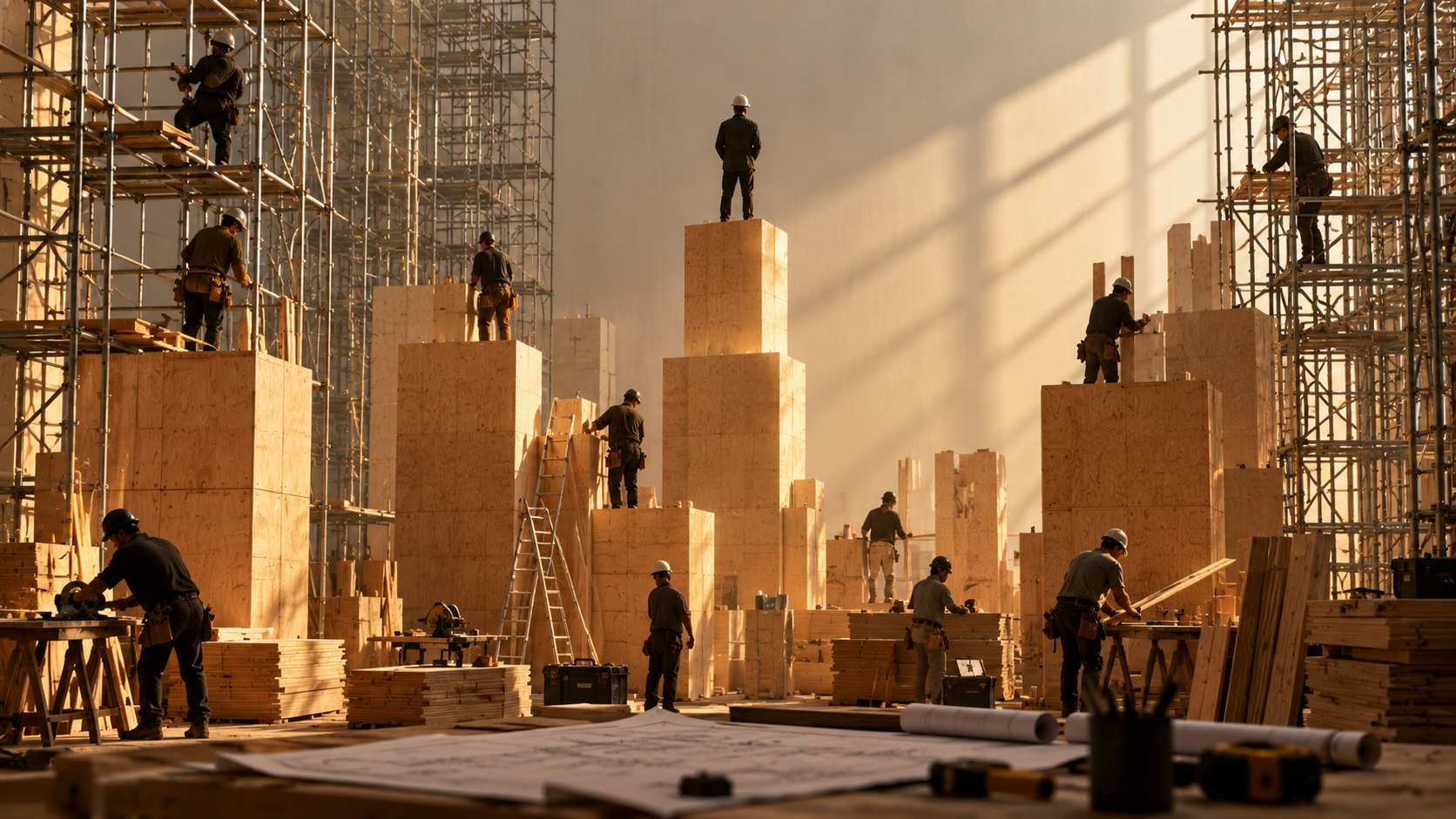
Harness engineering is transforming how software gets built. But are we preparing engineers to work differently?
For the past year, I've been engineering software without reading the code.
I don't review pull requests. I don't inspect implementations. I don't spend my days supervising agents as they work through individual changes. I describe what I want, evaluate what comes back, and correct what doesn't meet my expectations. I'm still responsible for the architecture, the quality, and the outcome. I've simply stopped treating direct involvement in implementation as a prerequisite for engineering.
And that brings me to one of the most interesting developments in AI engineering right now: harness engineering.
It's becoming another buzzword in an industry that produces them at an astonishing rate. But this one represents something genuinely transformative. We're moving beyond simply asking AI to write code. We're designing the environments, constraints, tools, feedback loops, and verification mechanisms that allow agents to perform increasingly complex engineering work with greater autonomy.
Yet much of the conversation remains focused on the machinery. How do we build better harnesses? How do we orchestrate agents? Where do we put humans in the loop? How do we review everything the agents produce?
Those are useful questions, but I think we're missing a much bigger one. We're building systems that no longer require engineers to participate in every implementation decision. And yet, we're still organizing much of our engineering practice around exactly that involvement.
I don't need a software factory to work differently. I can use ordinary AI coding tools and operate at the same level of abstraction. The factory makes that approach repeatable, autonomous, and scalable. But the technology isn't what makes the operating model possible. It's the engineering discipline behind how we direct, constrain, and evaluate the work.
As organizations begin delivering against this model, the gap is becoming difficult to ignore. We have tools capable of executing work at extraordinary speed. What we don't have is enough engineers prepared to direct that work without reverting to the development practices they've spent their careers learning. That's not a tooling problem. It's a capability problem.
Six weeks, one operator
On September 4, HydraFlow v2, 8th Light's software factory, was a specification. No code. A design, a plan, and a collection of opinions about how software should be produced when agents do the building.
Six weeks later, it has merged roughly 1,100 pull requests. It plans its own work, implements changes, runs verification, reviews the results, and merges what passes. A supervisor agent monitors the system, recovers stalled processes, and communicates with me through Slack.
The pull request count is a measure of throughput, not proof of quality. But the interesting part isn't how much code the factory produced. It's what I actually did during those six weeks, because it wasn't building software.
What the architect did
On day two, staging went red. Three pull requests had passed their individual checks but broke the build when merged together. I didn't debug the code. I changed the rule: nothing merges unless CI is green against the combined result. One architectural decision changed how the factory would handle every subsequent merge, and I didn't need to inspect the implementation to make it.
A few weeks later, I encountered the opposite problem. The factory was waiting on approvals and controls I'd established earlier. Those gates had seemed reasonable when I introduced them, but the evidence increasingly showed that I was becoming the bottleneck. Some controls were removed, others relaxed or delegated to automated verification. The important question wasn't whether we could eliminate human involvement. It was whether each control still justified its cost.
Knowing when to remove a control is just as much an architectural decision as knowing when to introduce one. In traditional development, an unnecessary approval might delay a developer. In an autonomous factory, the same approval can constrain an entire production system.
Another example came when the factory proposed a cohesion gate. It flagged 44% of production modules and 48% of test files. At first glance, those numbers suggested a significant quality problem. But the similarity between two different populations raised a more interesting question: was the measure identifying poor design, or merely describing characteristics common to both populations? I challenged the measure rather than automatically turning it into another gate.
No code inspection was required. What mattered was understanding what the metric actually told us and whether it justified an architectural constraint. These are the decisions I spend my time making now, not how to implement a feature, but what conditions must hold for the system to implement features reliably.
One operator, a hundred engineers' velocity, a thousand engineers' chaos
There's a phrase I've started using to describe what operating a software factory feels like: one person moving at the velocity of a hundred engineers, creating the chaos of a thousand.
It's not a literal headcount comparison. It's what happens when the rate of change is no longer limited by the number of people producing it.
Recently, in another factory experiment, I moved more of the workload onto dedicated hardware. On-premise CI reduced the cost of verification, additional CPU capacity allowed more builds to run concurrently, and centralized infrastructure gave the system room to expand. But removing those constraints exposed an entirely different class of problems.
During one particularly difficult evening, a change to shared branch history created 52 file conflicts across 23 dependent branches. Workflow state drifted from reality after restarts. Changes to the factory's own machinery interfered with work already moving through the system. None of these were fundamentally problems with generating code. They were problems of coordination, shared state, and operational control.
A large engineering organization has established ways of managing these problems. Teams coordinate migrations, freeze changes, manage ownership, and introduce controls around integration. Much of that discipline is embedded in the organization and its people. A factory operating at comparable throughput doesn't inherit those safeguards automatically, and one operator cannot personally coordinate every decision at that velocity.
So the architecture has to do it.
The system needs to reconcile its own state after failures, coordinate changes to shared infrastructure, limit conflicting operations, and test changes to its own machinery before applying them broadly. Perhaps most importantly, it needs to learn collectively. A failure discovered by one agent or workflow should become a test, constraint, or operational rule that protects every subsequent execution. Knowledge cannot remain trapped in individual sessions or depend on the operator remembering what happened.
The goal isn't to make one person capable of supervising a thousand changes. It's to architect a system that doesn't require them to.
That's where harness engineering becomes much more interesting than another collection of tools and prompts. We're designing the conditions under which software can be produced reliably at a scale that human-centered development practices were never designed to manage. And it demands a different kind of engineering judgment.
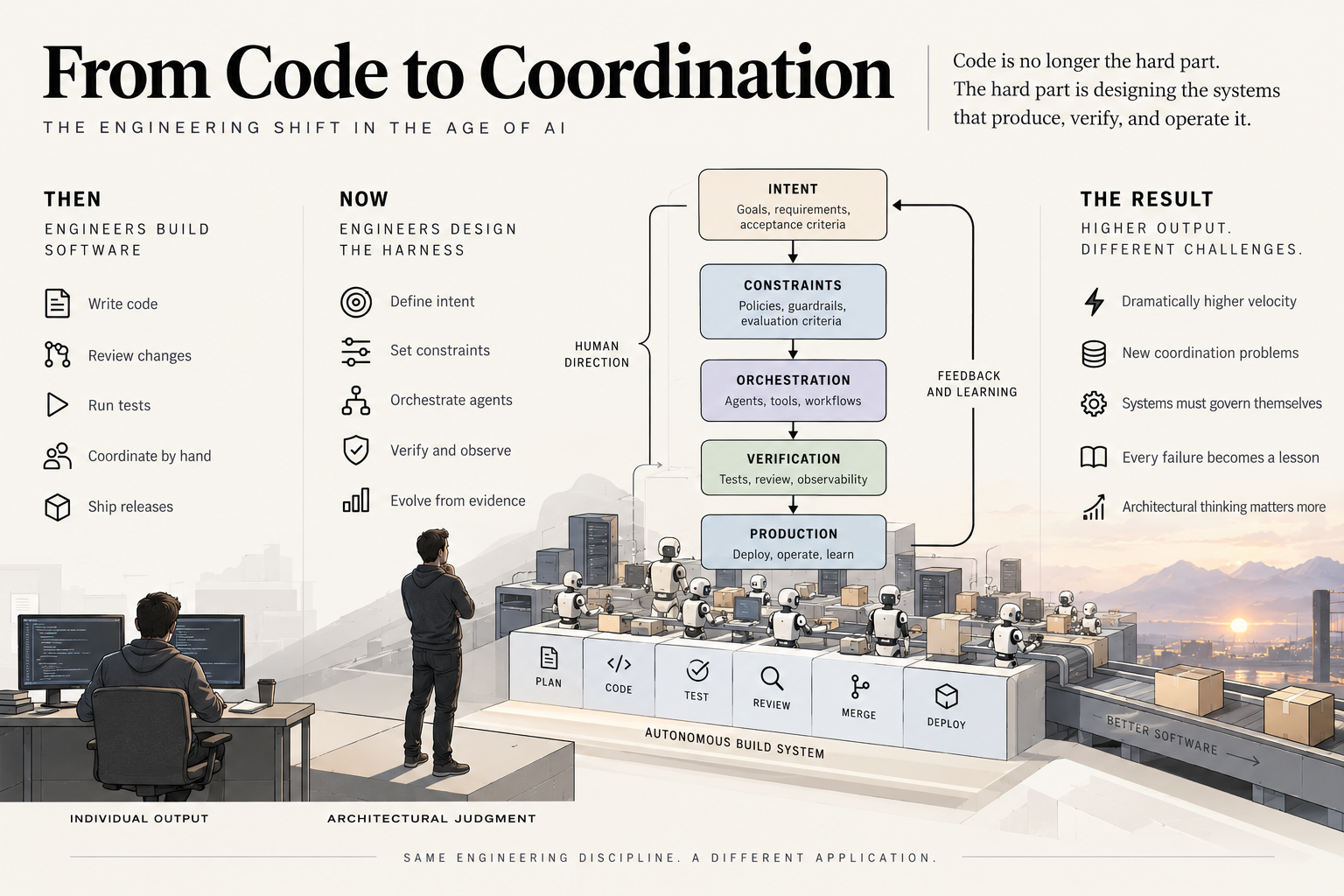
The industry needs to pivot
Here's where this becomes more than a story about software factories.
We have an industry full of extraordinarily capable engineers. People who understand distributed systems, security, architecture, infrastructure, and the complexities of production software. Yet give those same engineers increasingly capable AI tools, and we often see familiar development processes reappear. Tasks are assigned, implementations inspected, pull requests reviewed, and humans remain responsible for moving work through the system. We've changed the tools without fundamentally changing how we practice engineering.
This isn't a criticism of those engineers. It's what the industry has spent decades teaching us to do. Our processes, organizational structures, career ladders, and definitions of engineering excellence developed around a world where producing software required substantial human involvement in implementation. That world is changing, and the constraint is shifting from our capacity to produce software to our capacity to direct, constrain, and validate its production.
My experience scaling factory throughput has reinforced that shift. Every time we remove one constraint, another becomes visible. Implementation gives way to verification. Verification gives way to compute capacity. Compute capacity gives way to coordination, integration, and system coherence. The bottleneck keeps moving, and the problems become increasingly architectural.
The interesting thing is that we already possess much of the knowledge needed to address these problems. Reconciliation loops, trunk-based development, canary deployments, backpressure, and failure recovery aren't new inventions. What's changing is where that knowledge needs to be applied. Rather than relying on people to perform these activities around the development process, we need to encode more of that discipline into the systems doing the work.
That requires us to reconsider what engineering responsibility looks like. The technical depth we've accumulated remains enormously valuable, but we need to apply it differently. Architecture, verification, and operational control can no longer be practices that surround implementation. They increasingly need to define the environment in which implementation happens. Human judgment determines the boundaries, acceptable risks, and evidence required for the system to proceed, while the machinery handles the execution.
There's also a shift in how we think about knowledge. Traditional engineering teams rely heavily on what experienced people carry in their heads: why a decision was made, which components are fragile, what caused the last incident, and which changes shouldn't happen together. At machine speed, that knowledge needs to become durable and executable. Architectural decisions become constraints, lessons from incidents become automated checks, and operational experience becomes recovery behavior. The architect's job increasingly becomes turning engineering judgment into something the system can consistently apply.
This is the capability gap we need to address, and another workshop on coding agents won't close it. Experienced engineers need opportunities to practice directing execution, defining constraints, establishing evidence, and correcting systems rather than supervising every implementation. Our delivery practices, expectations, and measures of engineering effectiveness need to support that change. We cannot promise a fundamentally different approach to software delivery while continuing to organize the work as though nothing has changed.
And none of this requires building a software factory. The transition can begin with the tools we already have. The factory simply makes the limitations of our existing habits impossible to ignore.
In a room full of builders
The more I work this way, the more I find myself asking the same question. In a room full of builders, where are the architects?
Not the architects who produce diagrams and hand specifications to development teams. I'm talking about engineers who understand the shape of a system, establish the boundaries within which autonomous work can happen, evaluate the evidence it produces, and remain accountable for the result. People who can direct execution without needing to personally supervise every step.
For decades, we built our engineering practices around the human effort required to produce software. That assumption is beginning to fall away, but the profession hasn't fully adjusted to what comes next. This isn't a question for the next generation of developers. It's a question for all of us, particularly those who have spent our careers defining what good engineering looks like.
We've spent enormous effort teaching AI how to build software. Now we need to reconsider what it means to engineer when AI does the building.
The tools are changing how software is produced. It's time we changed how we practice engineering.